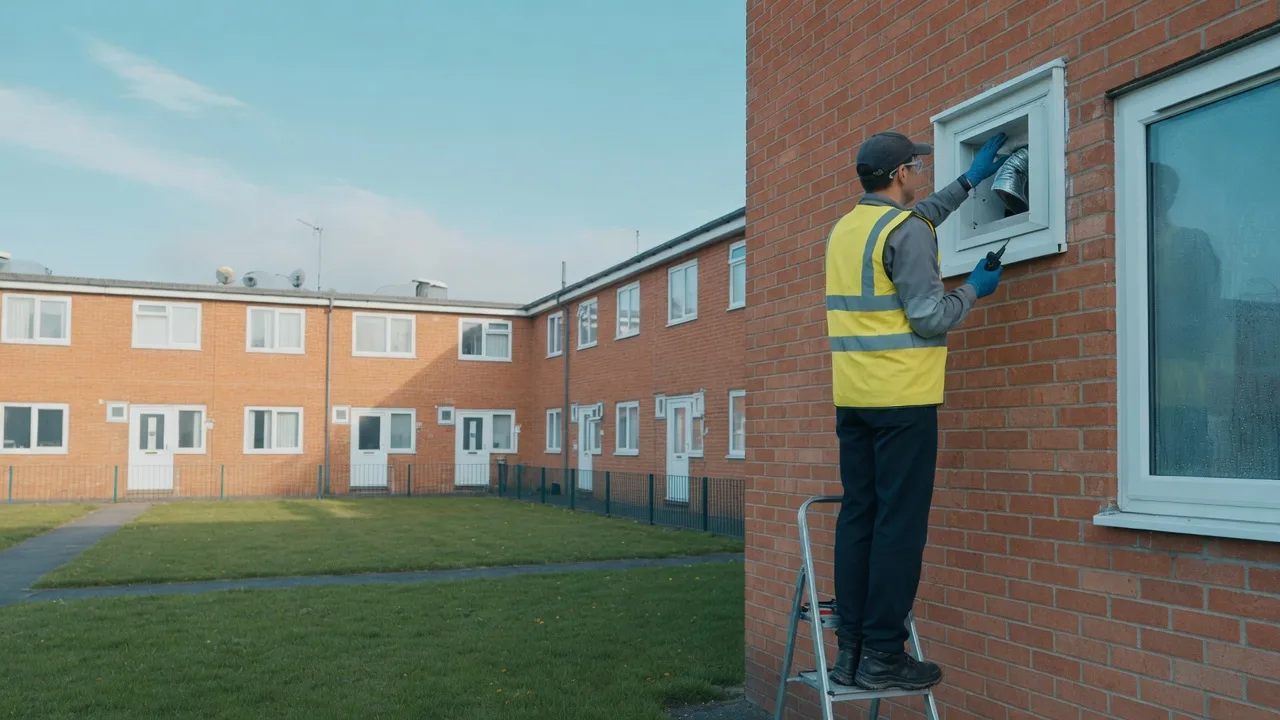
Social housing Compliance-critical
Ventilation and Ductwork Services for Social Housing
Duct cleaning, ventilation maintenance and fire-damper testing for social housing across London and the Home Counties.
Social housing Compliance-critical
Duct cleaning, ventilation maintenance and fire-damper testing for social housing across London and the Home Counties.
Social landlords carry a direct duty to keep homes free from damp, mould and poor indoor air quality. Clean, well-maintained ventilation is the mechanism that delivers it, and documented maintenance is how you prove compliance.
Clean Ducts provides ventilation and ductwork services to housing associations, local authorities and their facility managers across London and the Home Counties. You receive residential air-duct cleaning, mechanical ventilation maintenance, ventilation surveys and fire-damper testing, aligned to the standards that govern social housing stock.
Housing associations and local authorities face a distinct set of challenges, with damp, mould and poor indoor air quality now at the top of the list. Tenants report symptoms, regulators demand timescales, and the stock itself (much of it older, much of it recently sealed up for energy efficiency) works against you. The work here is built around three outcomes: protecting your housing stock, meeting your legal obligations and safeguarding the health of your tenants.
Teams operate throughout the Home Counties, including key locations in and around London, so response is prompt and disruption to residents stays low. Whether you manage a single estate or stock spread across several boroughs, you deal with one process and one standard of documentation.
Ventilation-hygiene work in occupied homes has to meet recognised standards and cause minimal disruption to tenants. The teams doing the work are qualified and experienced in the standards and legislation that govern the sector, so the evidence you file is produced by people who understand why it is being asked for.
Clean, functional ventilation is the most reliable way to control moisture, condensation and the mould growth that follows. These services support both your property-maintenance programme and your tenant-health obligations.
Dust, debris and allergens build up in air ducts over time, reducing ventilation efficiency and recirculating pollutants through the home. Cleaning to BESA TR19:
For tenants the difference is practical: a clean system moves the volume of air it was designed to move, which keeps humidity down and breaks the cycle that ends in condensation, damp patches and mould growth. For your maintenance team it restores the performance of equipment you have already paid to install, and it does so before poor airflow surfaces as a disrepair complaint.
Working ventilation is a legal duty for landlords, not an optional extra. We provide full lifecycle support for your properties’ ventilation:
In communal blocks, clean air handling units keep shared systems delivering fresh, filtered air to every dwelling they serve. Surveys carry a dual purpose in this sector: they give you an actionable route to compliance, and they show you where tenant health is most at risk so you can prioritise the right properties first.
In multi-occupancy housing, fire protection depends on ductwork behaving correctly during an emergency.
In an emergency, the ductwork that normally moves air around a building can move smoke instead. Fire dampers exist to close that path, and testing proves each one still operates as intended. Where access or condition is uncertain, camera surveys supply the visual evidence, so decisions about remedial work rest on what the ductwork actually looks like inside rather than on assumption.
Social housing providers face pressure from regulators, tenants and the public to deliver safe, healthy homes, and the recent focus on damp and mould has put ventilation at the centre of property management.
Many properties suffer from inadequate ventilation, particularly older buildings and homes that have undergone energy-efficiency improvements. Sealing a home to save energy without adding effective mechanical ventilation traps moisture indoors, leading directly to condensation and mould. This is common across high-density areas in and around London and the Home Counties, where refurbishment work is frequent.
These services are designed to be proactive. Rather than only cleaning existing problems, the inspections and maintenance prevent them from starting, which reduces costly reactive repairs and improves tenant satisfaction.
A planned programme also changes how your stock behaves as a portfolio. Instead of reacting property by property as complaints arrive, you work from a documented picture of every system’s condition, prioritise the dwellings most at risk and evidence progress as you go. That consistency is what keeps standards, and paperwork, uniform across estates in different boroughs and counties.
Clean Ducts covers social housing across London, Hertfordshire, Essex, Kent, Surrey, Berkshire and Buckinghamshire.
Social landlords in the UK carry clear legal duties for the condition and safety of their properties. Effective ventilation and duct cleaning are central to meeting them.
Regulators and auditors routinely ask for clear evidence of ventilation and duct maintenance during compliance reviews. The reports, registers and photographic evidence produced during cleaning, validation and fire-damper testing give you exactly that: a dated, documented trail you can put in front of an auditor without reconstructing history from job sheets.
The questions housing teams raise most often before booking work.
The right frequency depends on the type of system and the environment it serves, so a fixed interval quoted without seeing your stock is guesswork. The reliable route is a detailed ventilation survey across your properties: it assesses the level of contamination in each system and sets a maintenance schedule that keeps you compliant with health and safety standards. Regular inspections then keep that schedule honest, picking up build-up before it affects airflow or air quality. A schedule based on surveyed evidence is also far easier to defend in a compliance review than one based on habit.
A comprehensive BESA TR19-compliant report. It includes a complete register of all dampers, confirmation that each one was inspected, dropped (tested) and reset, photographic evidence and detailed location information for every unit. File it with your fire-safety records: it is the document your fire risk assessor, your auditors and your insurers will expect to see, and it removes any argument about whether the work was done.
Yes. Clean Ducts covers social housing across London and the Home Counties, including Hertfordshire, Essex, Kent, Surrey, Berkshire and Buckinghamshire. If your stock sits across several boroughs or counties, the same teams and the same documented process cover all of it, so a scattered portfolio still ends up with consistent standards and consistent records.
Poor ventilation allows pollutants and excess moisture to build up inside the home. That moisture is the primary contributor to condensation, damp and mould, which are linked to respiratory illnesses, allergies and asthma. Maintaining effective ventilation directly improves health outcomes for your residents, and it reduces the risk of complaints escalating into the kind of legal challenge that Awaab’s Law now puts on a statutory footing.
A documented survey shows exactly where your ductwork, extract systems and fire dampers stand against current standards. Request a social-housing ventilation survey to establish a clear, evidence-backed baseline across your stock. Every later visit is then measured against it, so improvement is demonstrable rather than asserted.
Request a free survey. A named engineer walks the system and puts what’s compliant, and what isn’t, in writing within 24 hours.